EV chargers are going into Connecticut parking lots fast: apartment complexes, office parks, hotels, plazas and municipal lots. The charger installer handles the electrical work. Somebody still has to mark the spaces, and that is where a lot of properties end up with a charger in the middle of an unmarked lot and cars parked in front of it. Here is how EV space striping works and what the state expects.
What Connecticut requires
Connecticut's 2022 Clean Air Act (Public Act 22-25) added EV-ready parking requirements to the state's building rules. In short, new commercial and multifamily buildings with 30 or more parking spaces need to be built so at least 10 percent of the spaces can support Level 2 or DC fast charging, and towns are allowed to require more. New state buildings have a higher target. The exact wording and how it is applied comes through the State Building Code and your local building official, so check with the town on a new project.
For existing lots there is no state requirement to install chargers. But once a charger is installed, the space it serves needs to be marked so it works, and if it is an accessible space it has to meet the accessible dimensions.
What to paint
A typical EV charging space gets:
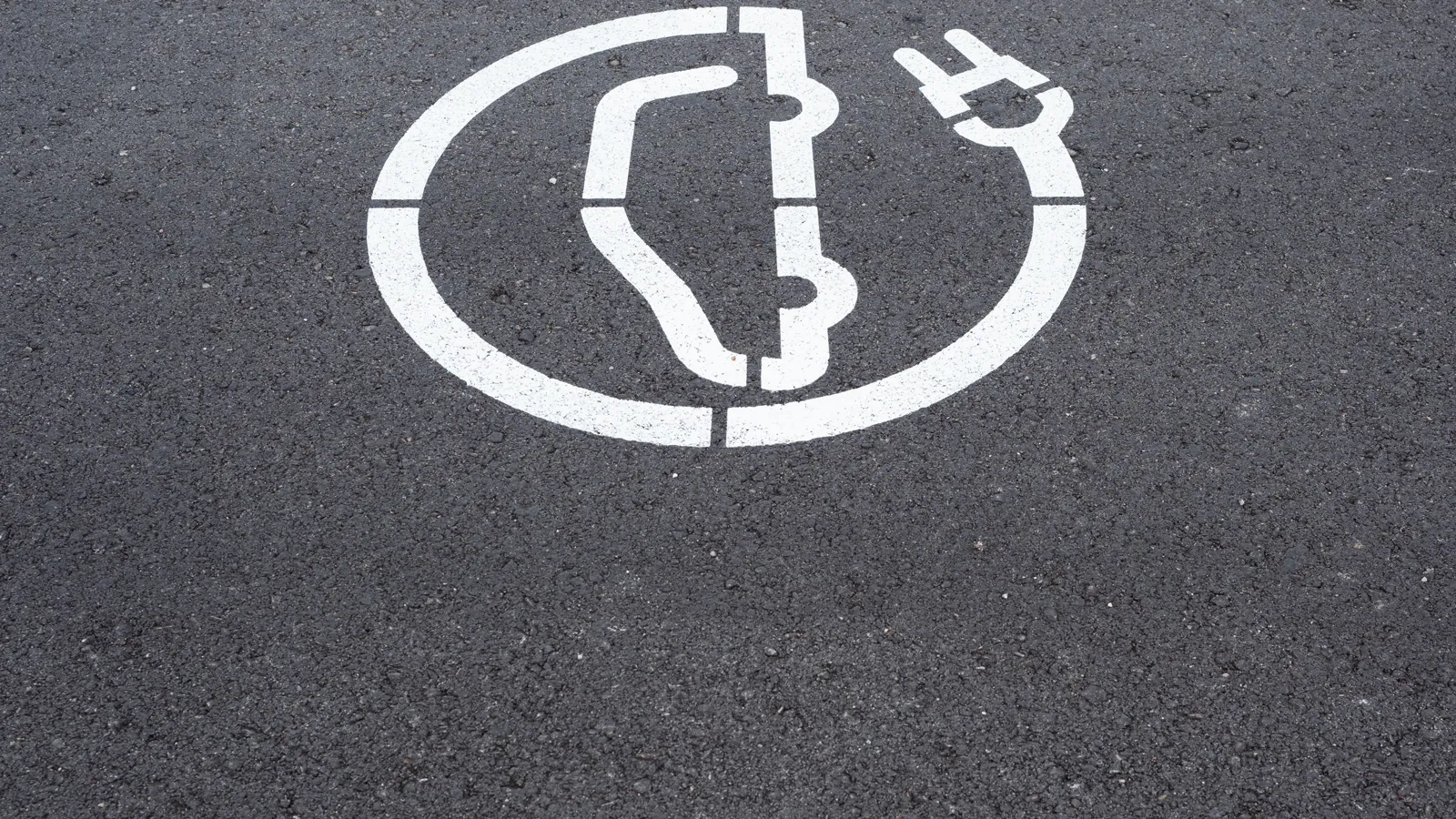
- The EV charging symbol (a car with a plug, or a plug alone) painted in the stall. White on asphalt, or white on a green or blue background if you want it to stand out.
- Lettering such as EV CHARGING ONLY or EV PARKING ONLY. Some charger networks have their own standard text; follow it if they do.
- Standard stall lines at the lot's regular stall size, with a little extra length if the charger pedestal sits at the head of the stall and the cable has to reach the port.
- A hatched no-parking zone around the charger pedestal and the bollards protecting it, so nobody parks against it or trips over the cable.
- Signs, usually required by the town and by the charger network, stating the space is for EV charging and whether there is a time limit.
Green background with white symbol is the most recognizable treatment and matches what drivers see at public charging stations. Blue is best avoided for EV spaces because blue means accessible parking.
Accessible EV spaces
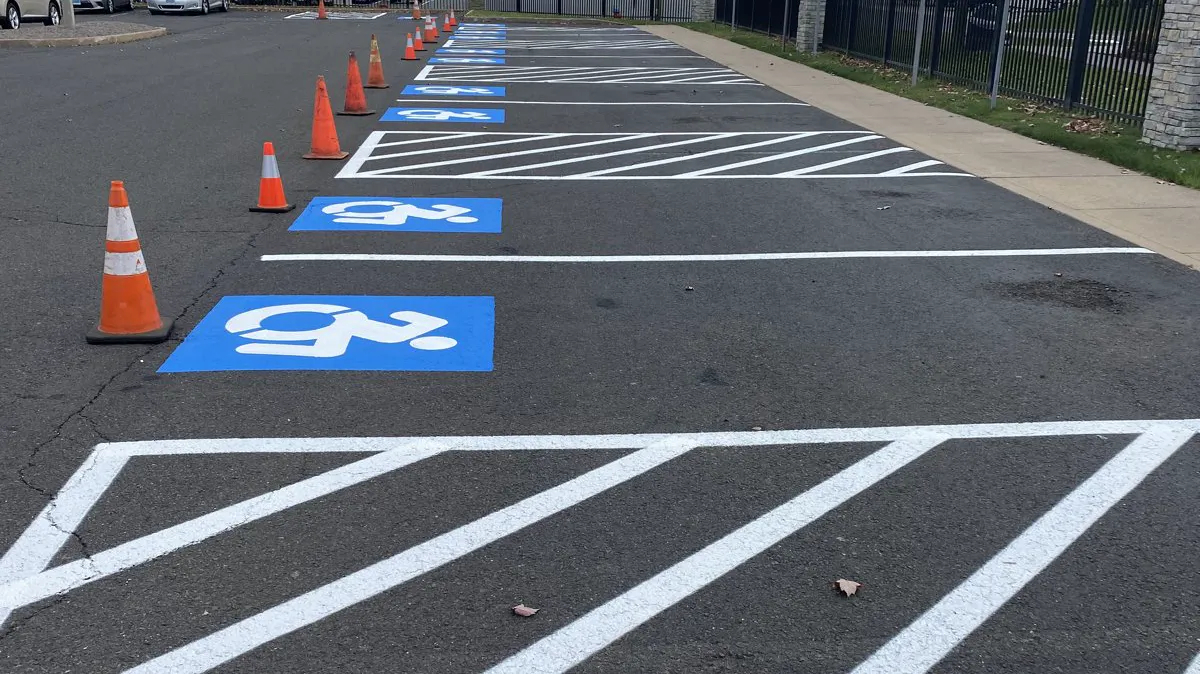
This is the part most properties miss. If any of the EV charging spaces are counted as accessible spaces, or if the charger is meant to serve drivers with disabilities, those spaces have to meet the Connecticut accessible dimensions: 15 feet wide including a 5 foot aisle for a car space, 16 feet wide including an 8 foot aisle for a van space. The 2025 update to the state statute (Public Act 25-108) specifically allows the State Building Code to require wider accessible spaces where an EV charger is present, because the charger pedestal, the cable and the aisle all need room.
The access aisle also needs a clear path to the charger. A charger mounted at the back of a curb that a wheelchair user cannot reach from the aisle does not count.
Federal accessibility guidance for EV charging stations is still developing, and towns handle it differently. The safe approach on a new install is to make at least one EV space accessible, lay it out to the Connecticut widths, and keep the aisle clear of the pedestal and bollards.
Where to put EV spaces
- Near the electrical source, which the installer will decide.
- Close enough to the entrance to be convenient, but not in the prime spots unless you want them to fill up with non-EVs.
- Grouped, so the hatched zone and signs cover them together.
- Away from the fire lane and not blocking an accessible route.
Common mistakes
- No markings at all. The charger goes in, the stall stays plain, and the space gets used by whoever gets there first.
- Symbol only, no lettering or sign. Drivers who do not know the symbol park there anyway. Towing a car from an EV space usually requires a posted sign.
- Blue backgrounds. Confuses the EV space with accessible parking.
- Charger in the aisle. An EV pedestal installed inside the cross-hatched access aisle of an accessible stall is a violation.
- No protection for the pedestal. Bollards or wheel stops plus a hatched zone keep the charger from being hit.
Doing it with the rest of the lot
EV markings are quick to add when we are already striping the lot. If chargers are going in this season, tell us the install date and we will schedule the striping right behind it, including the symbols, lettering, hatching and any accessible stalls that need re-laying. We also do stencils and custom text for network-specific wording.
Request a quote or call Rick at (860) 906-7740.
This article is general information. Your building official, the State Building Code and the charger network's requirements control what applies to your property.